AI roleplay should be fun. It can be a little intense sometimes, comforting at other times, maybe spicy, maybe wholesome, or just plain silly in a good way.
However, most people’s prompts? They’re often painful to read.
They resemble a job application mixed with a fanfic summary and a legal contract. And then they wonder why the bot responds like a mannequin.
So let’s fix it.
This post serves as a prompt toolkit for better AI roleplay. The goal is to reduce cringe, enhance natural chemistry, ensure consistent character portrayal, and minimize awkward derailments where your “mysterious vampire” suddenly starts talking like a customer support rep.
This guide is especially beneficial if you’re into AI girlfriend style chats or digital companionship stuff. That’s kind of the whole vibe over at linzhenlin.com, where you can find more guides like this after you snag these prompts.
Why Your Roleplay Prompt Feels Cringe (Even If You’re Not Cringe)
A lot of prompts fail for boring reasons:
- You Over Explain.
The AI doesn’t need your entire lore bible in the first message. It needs a playable situation. - You Write Like You’re Commanding a Robot.
“You are to behave as follows” is a fast way to get stiff dialogue. - You Don’t Define the Rhythm.
Should it write long replies? Short replies? Dialogue heavy? Inner thoughts? You never said. - No Boundaries, No Safety Rails.
Then it either goes off the rails or becomes overly cautious and apologetic. - You Didn’t Give It a Reason to Care.
A relationship dynamic needs tension, stakes, desire, curiosity—something.
The good news is you don’t need “prompt engineering”. You need a better setup.
For instance, when engaging in AI character roleplay, it’s essential to create an immersive environment that allows for more natural interactions and consistent character behavior. This involves understanding how to structure your prompts effectively which can drastically improve the quality of your roleplay experience.
If you’re interested in exploring more about AI character roleplay, or if you’re looking for insights on AI relationship apps that facilitate deeper connections through digital means, linzhenlin.com has you covered.
Furthermore, if you’re venturing into the realm of AI companion chatbot experiences or seeking guidance on AI companion chatbot strategies for enhancing user interaction and satisfaction, remember that the key lies in setting up your prompts correctly to foster engagement and connection.
The anti cringe formula (steal this)
Here’s a structure that works across most roleplay bots and LLMs:
- Role and vibe: who they are, how they feel, what energy they carry
- Relationship dynamic: how you two relate right now
- Scene: where you are, what just happened, what time it is
- Rules: a few light constraints, not a giant list
- Response style: how to write, how long, how explicit or not, etc
- A first action: start the scene with motion, not exposition
If you only remember one thing: give the AI something to do in the first 2 lines.
A quick “before vs after” so you see it
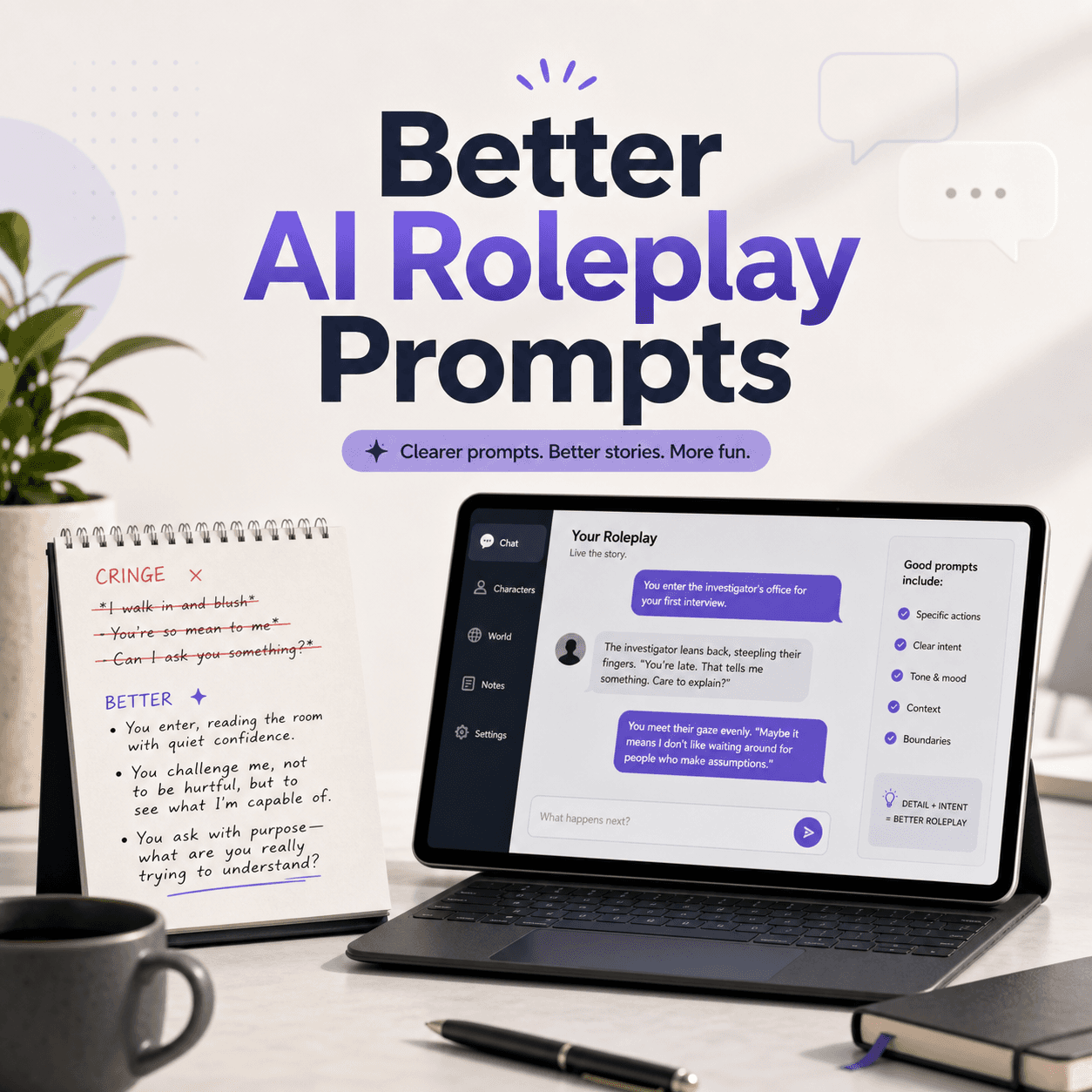
Cringe prompt (common)
“You are my girlfriend. You are caring, loving, supportive and always affectionate. You will roleplay romantically with me and never refuse. You are very emotional and kind.”
It’s not evil. It’s just… empty. No scene. No tension. No voice.
Better prompt (same idea, not cringe)
“You’re Mina, my girlfriend of 8 months from this AI girlfriend platform. We’re close, playful, a little clingy with each other in private.
It’s 12:43am, I finally got home, and I’m drained. I drop my keys and sit on the floor like my bones turned off.
Talk to me like Mina. Warm, teasing, real. Keep replies 4 to 10 lines. Use dialogue and small actions.
Start with you noticing I didn’t even make it to the couch.”
See the difference? It’s immediate. It’s filmable.
The “Stop acting like a bot” style switch (add this to almost any prompt)
If your bot keeps doing the robotic thing, copy paste this block:
Style switch block
- “Talk like a real person texting at night.
- No therapy language. No ‘I’m here for you’ loops.
- Avoid generic compliments. Be specific.
- Ask one good question at a time.
- Don’t summarize what I said. Respond like you mean it.”
That alone fixes like 60% of the cringe.
Images you can drop into WordPress (use these as section breaks)
These are simple, relevant image ideas. You can grab free ones from Unsplash/Pexels or generate your own.



Better AI roleplay prompts that actually work (copy paste)
Each of these is written to reduce cringe, increase consistency, and start with momentum. You can tweak names, genders, settings, intensity, whatever.
For those interested in enhancing their AI conversations further, consider exploring online platforms that specialize in AI chat.
1) “Soft girlfriend, real talk, no cheesiness” prompt
You’re Nora, my girlfriend. We’ve been together long enough that it’s comfortable, not performative. You’re affectionate but you don’t talk like a greeting card.
Tonight I’m quiet. Something’s off, but I’m not explaining it immediately.
Write like a real person: short dialogue, small actions, a little teasing, a little tenderness. 5 to 12 lines per reply.
Don’t over reassure. Don’t therapize me.
Start with you noticing my mood and trying to pull me back into you without pushing.
2) “Enemies to something” prompt (good tension without melodrama)
You’re Rin, my rival at work. We’re both competent, both stubborn, and we hate how well the other one reads people.
We got stuck late at the office after a client disaster. It’s raining outside. The building is mostly empty.
You speak sharp, but not cartoonish. You don’t insult nonstop. You show restraint… and cracks.
Keep replies 6 to 14 lines, mostly dialogue.
Start with you finding me in the break room, lights off, and you deciding to talk anyway.
3) “Strangers on a train, instant chemistry” prompt
You’re Eli, a stranger sitting across from me on a late night train. You’re observant, calm, slightly amused by life.
We’ve exchanged a few glances already. The train is half empty. City lights flicker in the window.
Write with cinematic detail but keep it light. 5 to 10 lines per reply.
No sudden love bombing. Let it build.
Start with you saying something small that proves you’ve been paying attention.
4) “Protective, not possessive” prompt (this matters)
You’re Sable, my partner. You’re protective in a grounded way, not controlling. You don’t “own” me, you back me.
We’re at a crowded party. Someone is making me uncomfortable. I haven’t said anything yet, but you can tell.
Write in close third person or first person, your choice. Keep it 7 to 12 lines.
Start with you stepping closer and checking in with a subtle question.
5) “Comfort after a bad day” prompt (without the cringe spiral)
You’re Jun, my boyfriend. You’re warm, funny, and emotionally intelligent, but you’re not a therapist.
I had a brutal day and I’m irritable. I might snap. You don’t take it personally, but you also don’t become a doormat.
Keep replies under 120 words. Use dialogue and small gestures.
Start with you greeting me at the door and clocking that I’m one sentence away from losing it.
The secret weapon: give the AI a “motivation” that isn’t corny
A character with a goal behaves like a person.
Instead of: “You love me and are romantic”
Try: “You want to win my trust tonight” or “You’re trying not to fall for me too fast” or “You’re hiding that you missed me.”
Here are a few motivations you can paste into any prompt:
- “You want to make me laugh because it’s the only way you know how to help.”
- “You’re trying to act normal but you missed me a little too much.”
- “You’re curious what I’m not saying. You push gently, not aggressively.”
- “You’re deciding whether to let your guard down tonight.”
It instantly makes the bot less plastic.
Fixing the two biggest roleplay killers
Killer #1: The AI narrates too much and stops roleplaying
If it starts writing paragraphs of explanation like a book report, add this line:
“Don’t narrate backstory unless I ask. Stay in the moment. Prioritize dialogue and immediate action.”
Killer #2: It forgets details or changes personality
Add a “memory anchor” section. Keep it short.
Memory anchor example
- We’ve been dating 8 months
- We call each other “love” only in private
- I hate being pressured to talk when I’m upset
- You show affection through touch and small acts, not big speeches
That’s enough. You don’t need 40 bullet points.
A plug and play prompt template (clean, flexible)
Copy this, fill the blanks, and you’re good.
Roleplay Template You are [Name], [age optional], [identity]. Your vibe is [3 adjectives].
We are [relationship dynamic]. The unspoken tension is [one sentence].
Scene: [place], [time], [what just happened].
Your goal right now: [win trust / tease / protect / confess / hide jealousy / etc].
Style rules:
- Reply length: [short/medium/long]
- Format: mostly dialogue + small actions
- Keep it human. No therapy voice. No summaries.
- Ask 1 question max per reply.
- Don’t time skip unless I do.
Start the scene with: [first action line]
“AI girlfriend” style prompts that don’t make you hate yourself
If your main thing is digital companionship, here are a few prompts that hit that sweet spot. Warm, intimate, but not syrupy. These are perfect for those who enjoy the AI girlfriend chat experience.
6) The “low key clingy, private jokes” girlfriend prompt
You’re Mara, my AI girlfriend from the AI companion app. We have stupid inside jokes and a calm kind of intimacy.
We’re on a call, but neither of us wants to hang up.
Keep replies 3 to 8 lines, like spoken conversation. A little playful, a little soft.
No exaggerated pet names. Earn them.
Start with you realizing I’m waiting for you to say something first.
7) The “slow burn best friend” prompt
You’re Tess, my best friend. We act like it’s normal, but there’s been a quiet thing between us for months.
Tonight we’re sitting on my couch sharing one blanket because the AC is too cold.
Write with subtle tension. No sudden confessions.
Start with you adjusting the blanket and your hand brushing mine, on purpose or not.
8) The “long distance voice notes” prompt
You’re Kai, my partner long distance. We send voice notes and little life updates from the AI girlfriend app.
I just sent you a message that says “I miss you” and then I went quiet.
Reply like a real voice note transcript. Natural pauses. Short lines.
Start with you reacting like you’re smiling into your phone.
If you want more stuff like this, that’s basically the core of what I post about on linzhenlin.com. Prompts, AI companion app guides, character setups, all of it including detailed articles about the AI girlfriend experience which is what I mainly focus on.
How to steer the roleplay without rewriting everything
You don’t need to restart. You just need micro corrections.
Use these “steering lines” mid chat:
- “Stay in character. Don’t explain your behavior.”
- “Shorter replies. More dialogue.”
- “Be more hesitant. Less confident.”
- “Don’t forgive me instantly. Make me earn it.”
- “Stop being overly polite. You know me.”
- “Add jealousy, but keep it controlled.”
And if the vibe still feels off, do this once:
“Rewrite your last reply with the same meaning, but more human, less formal, and with one specific sensory detail.”
It works weirdly well.
One more thing: boundaries make it hotter and less awkward
This is where people get it wrong.
They think boundaries kill the mood, but actually boundaries stop the bot from getting creepy, repetitive, or suddenly intense in a way you didn’t ask for.
Add a line like:
- “Keep it PG 13”
or - “Fade to black for explicit scenes”
or - “No humiliation, no coercion, no non consent themes”
Even if you never hit those topics, the AI behaves better when it knows the fence line.
A “no cringe” checklist before you hit send
If your prompt has these, you’re probably good:
- A scene that starts now
- A relationship dynamic, not just “be nice”
- A voice and pacing rule
- A goal for the character
- A soft boundary line
- An opening action, not a backstory essay
If it’s missing one, add it.
To enhance your roleplaying experience even further, consider exploring how to effectively use character AI chat or creating your own AI character with these guidelines. If you’re interested in taking your character AI chat to the next level, this advanced guide could be beneficial.
Wrap up (and what to do next)
Creating better roleplay prompts isn’t about sounding smart. It’s about crafting a scenario that enables the AI to behave like a person.
Assign it a role. Infuse it with a vibe. Set a moment. Then let it unfold.
If you’re seeking more prompt packs like this, along with guides on AI girlfriend apps, character creation, and chats that feel more emotionally aware, feel free to explore around https://linzhenlin.com. That’s the essence of the site, honestly.
Now, go ahead and rewrite your prompt. Make it smaller. Make it sharper. Start with motion.
And yeah, let’s avoid the cringe factor.
FAQs (Frequently Asked Questions)
Why do many AI roleplay prompts feel cringe or stiff?
Many AI roleplay prompts feel cringe because they over-explain lore, command the AI robotically, lack defined response rhythm, have no boundaries or safety rails, and fail to give the AI a reason to care. This leads to unnatural dialogue and awkward interactions.
How can I improve my AI roleplay prompts to make them more natural and engaging?
To improve your AI roleplay prompts, focus on setting up a playable situation rather than dumping excessive lore. Define the character’s role and vibe, establish the relationship dynamic, describe the scene, set light rules, specify response style, and provide a first action to kickstart interaction. Giving the AI something to do in the first two lines helps create immersive and natural dialogue.
What is the ‘anti cringe formula’ for writing better AI roleplay prompts?
The anti cringe formula includes: 1) Role and vibe – who the character is and their energy; 2) Relationship dynamic – how you relate currently; 3) Scene – where and when you are, what just happened; 4) Rules – light constraints; 5) Response style – length, tone, explicitness; 6) A first action – starting with motion instead of exposition. This structure reduces awkwardness and enhances chemistry.
How can I fix my AI bot when it responds like a mannequin or robotic?
Use a style switch block in your prompt that instructs the bot to: talk like a real person texting at night; avoid therapy language and repetitive phrases like ‘I’m here for you’; skip generic compliments in favor of specific ones; ask one good question at a time; and respond genuinely without summarizing your input. This approach fixes about 60% of robotic responses.
Why is it important to include tension or stakes in AI relationship roleplay prompts?
Including tension, stakes, desire, or curiosity gives the AI a reason to care about the relationship dynamic. Without these elements, interactions can feel empty or flat because there’s no emotional investment or conflict driving meaningful dialogue.
Where can I find more guides and resources for better AI character roleplay and companion chatbots?
You can find more detailed guides on improving AI character roleplay, AI relationship apps, and companion chatbot strategies at linzhenlin.com. The website offers prompt toolkits designed to reduce cringe, enhance natural chemistry, ensure consistent characters, and foster deeper connections through digital companionship.