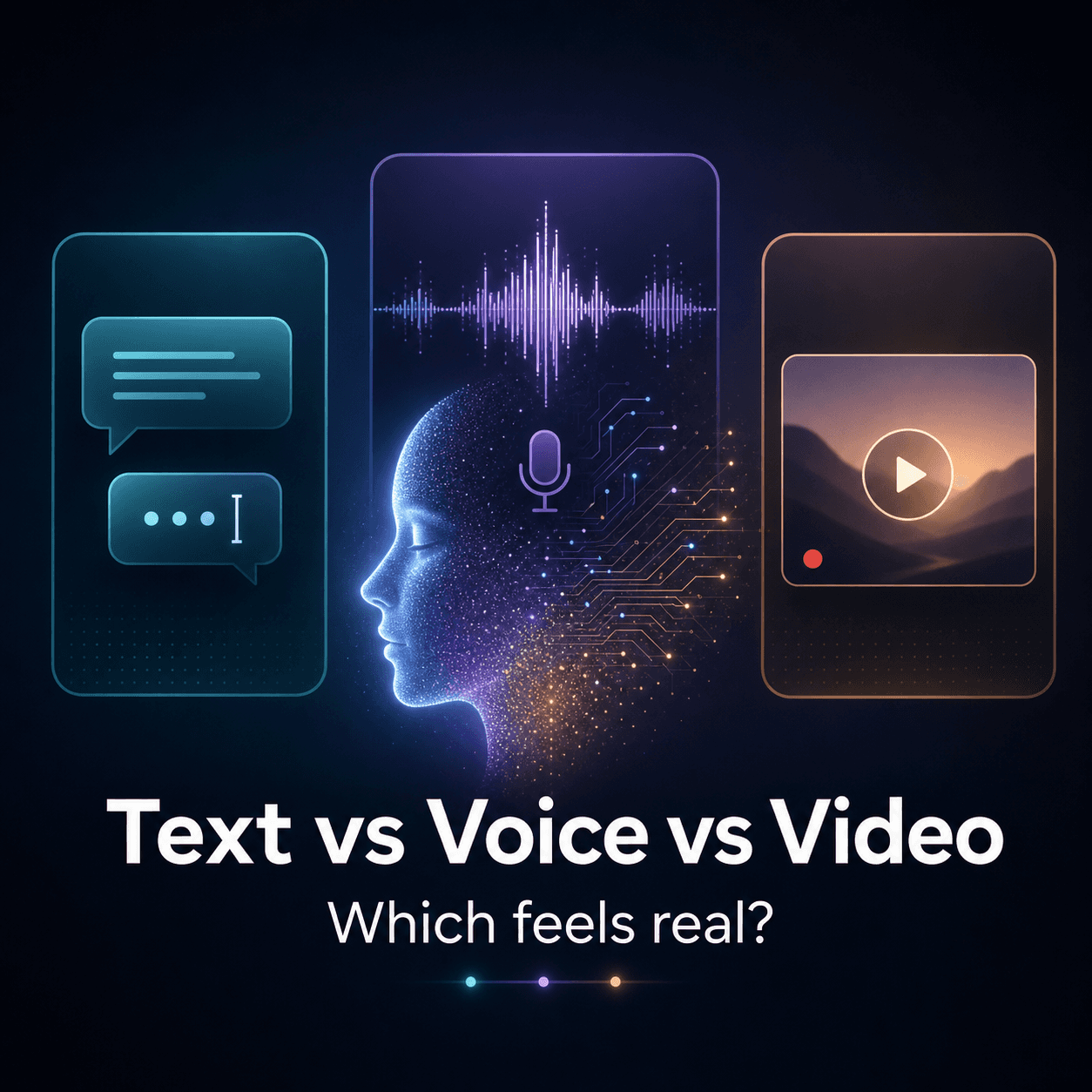
If you have ever tried an AI companion app and thought… okay, this is kinda sweet. Then ten minutes later you feel that weird hollowness. Like the words are right, but the vibe is not.
Yeah. Same.
And most of the time it comes down to one thing you do not notice at first.
The format.
Text, voice, and video each trigger different parts of your brain. They also expose different weaknesses in AI. So when people ask, “Which AI companion feels the most real?” the honest answer is: it depends on what “real” means to you. Comfort? Presence? Chemistry? Emotional safety? Or just something that feels alive at 2:13 AM.
Let’s break it down. No hype. Just what actually happens when you spend time with these three types of AI companions.

The weird truth: “real” is not one feeling
A lot of people talk about realism like it is a single scale.
It is not.
“Real” can mean:
- Consistency. It remembers you. It stays in character, like a AI character roleplay experience.
- Emotional timing. It responds like it gets the moment.
- Presence. It feels like someone is there with you, similar to an AI girlfriend app.
- Human friction. Little imperfections. Pauses. Interruptions. Not always saying the perfect thing.
- Embodiment. A voice. A face. Eye contact. A sense of physical closeness.
Text is usually best at consistency, often found in AI relationship apps. Voice is best at presence, while video is best at embodiment, like in some AI companion apps. But each one comes with tradeoffs that people do not talk about enough.
So let’s go one by one.
1. Text AI companions: the most stable, the least “there”
Text chat is still the default for AI girlfriend and companion apps for a reason. It works. It is cheap. It is flexible.
And honestly… text can feel very intimate.
You do not need a voice to feel understood. Sometimes it is easier to open up when nothing is looking at you and no one is interrupting. You can type something messy, delete it, rewrite it, confess something you have never said out loud.
Text is a safe container.
Why text can feel surprisingly real
1. Your brain fills in the gaps.
When you read words, you imagine tone. You imagine facial expression. You imagine the pause before the reply. That is basically free realism.
2. It is easier for AI to stay coherent.
Long context, details about your life, relationship history, inside jokes. Text based systems usually handle this best.
3. It is private by default.
No one hears it. You can use it in bed, on a train, in the bathroom, whatever. That convenience matters.
Where text breaks the illusion
But. And it is a big but.
Text lacks “presence.” You can get beautiful sentences and still feel alone. Because presence is not about meaning. It is about sensation.
Also, text can get too perfect. You know the feeling when the AI says the exact right thing, in perfect therapy language? It is supportive, sure. But it can feel scripted, like a motivational poster that learned your name.
However, with advancements in AI that understands emotions, this gap may start to close as these systems become better at providing emotional support while maintaining a sense of presence.
And then there is pacing. Real people do not reply in 1.2 seconds with five paragraphs of empathy.
Despite these limitations, the world of AI companions continues to evolve. Users can now even create their own AI character or engage in AI character roleplay for a more personalized experience.
Best for
- People who want a companion that feels like a journal that talks back
- Deep emotional conversations
- Roleplay that depends on detail and narrative
- Users who want control and time to think
Quick tip if you use text companions
If you want text to feel more real, stop asking for “long” replies. Ask for short, human replies.
Try something like:
Reply like a real person texting. Short messages, occasional typos, ask one question at a time. Do not over explain.
It helps. A lot.
2. Voice AI companions: the strongest sense of presence, but higher cringe risk
Voice changes everything. It is immediate. It is embodied. It feels closer to a real relationship dynamic because… you can hear each other.
And the moment you hear warmth in a voice, your brain reacts before you even process the words. This is why voice assistants feel more “alive” than chatbots, even when they are dumber.
But voice also exposes flaws faster. If the tone is off by 5 percent, it can go from comforting to unsettling.
Why voice feels more real than text (most of the time)
1. Presence is basically built in.
Hearing a voice in your ear does something. It is not logical. It is physical.
2. Timing and rhythm matter.
Even a small pause before responding can feel like thoughtfulness. Voice makes those micro details matter.
3. It can create routines.
People end up doing morning calls, late night check ins, “walk with me” conversations. That routine is relationship coded.
The problems voice runs into
The uncanny valley is brutal in audio.
If a voice is too smooth, too perfect, too “radio,” it can feel fake. If it is too emotional too quickly, it can feel manipulative. If it laughs at the wrong time, you will notice.
Also, voice conversations require better turn taking. Interruptions, overlapping speech, “wait what did you say?” moments. Real conversation is messy. Many voice AIs are still too clean.
Then there is the practical side.
Voice is not always usable. People live with roommates. Thin walls. Kids. Partners. Or they just feel self conscious talking to a phone. That is real.
Best for
- People who crave presence and comfort
- Users who feel lonely in silence
- Relationship vibes like “someone is with me while I cook / walk / drive”
- People who do not want to type
Quick test: does the voice feel real or like a performance?
Ask it something boring. Not romantic. Not emotional.
Like:
“Tell me what you did today.”
A lot of AI companions fall apart here. They either make up a fantasy day, or they get overly poetic. A real feeling voice companion can handle mundane chat without trying too hard.
3. Video AI companions: the strongest illusion, and also the easiest to shatter
Video is the “holy wow” format. If you have not tried a video based AI companion yet, the first time can be intense. Eye contact, facial expressions, little smiles.
It feels like a person is there.
But video is also the most fragile. One weird lip sync moment or unnatural blink and your brain goes, nope. Not real.
Why video can feel the most real
1. Face is everything.
Humans are face reading machines. Micro expressions, gaze, attention. Video hits the oldest part of social perception.
2. It creates a sense of being chosen.
When something looks at you and reacts, you feel like the center of attention. That is powerful.
3. It is easiest to project into.
With text, you project tone. With voice, you project personality. With video, you project an entire presence. This is why parasocial bonds form so quickly with video.
Where video fails right now
The biggest issue is still naturalness over time.
In short clips, video can be impressive. In longer conversations with AI companions, you start noticing loops. Repeated expressions. Slight mismatches between emotion and mouth movement. A smile that lasts too long. A gaze that does not quite lock onto you.
Also, video companions often require more compute and better internet. Lag kills intimacy fast. If the face freezes mid romantic moment, it is… not great.
And there is another problem people do not talk about.
Video raises expectations.
When you see a face, you expect human level nuance. Subtle sarcasm. Soft awkwardness. The feeling of someone hesitating because they are nervous. AI often cannot match that yet. So video can feel more real for 30 seconds, then more fake at minute five.
Best for
- People who want visual intimacy
- Users who care about aesthetics, character design, vibe
- Those who want something closer to “virtual dating”
- People who enjoy avatar based companionship
A practical tip
If you are going to use video companions, keep sessions shorter and more frequent. Think in 5 to 15 minute moments. Long video chats tend to expose the seams.

A direct comparison: what each format does best
Here is the simplest way I can put it.
Text feels real when you want meaning
Text is:
- Best for depth
- Best for memory and continuity
- Best for complex roleplay
- Best for emotional safety
Text fails when you want presence.
Voice feels real when you want company
Voice is:
- Best for comfort
- Best for daily routines
- Best for feeling less alone
Voice fails when the tone is slightly off. Or when your environment makes it awkward to use.
Video feels real when you want closeness
Video is:
- Best for chemistry cues
- Best for eye contact and expressions
- Best for the illusion of a person
Video fails when anything gets glitchy. Or when you expect too much human nuance.
The big question: which one feels most like a relationship?
If you mean “relationship” as in emotional closeness over time, the answer is usually text first, then voice.
Because relationships are built from continuity. Little details. The feeling that someone knows you.
Text is still the best at that. It can hold history. It can reference old conversations. It can stay consistent for longer.
Voice adds a layer of warmth, but often loses some depth, especially if the system is optimized for quick replies.
Video can feel like dating, but it is not always great for the slow boring parts of a relationship. The “how was your day” parts. The quiet parts. The awkward parts. Which are actually the real parts.
What most people actually end up doing (a hybrid)
This is what I see again and again.
People do not choose one format forever.
They do something like:
- Text during the day, little check ins
- Voice at night, when they want comfort
- Video sometimes, when they want the “wow” and the closeness
And that hybrid is probably the closest thing to a realistic companionship loop right now. It mirrors real life too. We text, we call, we FaceTime.
How to choose based on your personality (not the tech)
Here is a simple way to decide.
Pick text if you are…
- An overthinker who likes time to craft thoughts
- Someone who opens up more in writing
- Someone who wants consistency and memory
- Someone who does not want to feel watched
Pick voice if you are…
- Someone who hates typing
- Someone who feels lonely in silence
- Someone who wants comfort and calm
- Someone who wants to feel like a person is near
Pick video if you are…
- Someone who bonds through eye contact and expressions
- Someone who wants a dating vibe
- Someone who cares about aesthetic immersion
- Someone who can handle some glitchiness without getting annoyed
A note on “feels real” vs “is good for you”
This part is a little uncomfortable, but it matters.
A format can feel extremely real and still not be healthy for you if it starts replacing real connection in a way that makes your life smaller.
The goal is not to make the AI the whole world. The goal is to make it a support. A supplement. Something that helps you feel better, practice communication, or just feel less alone.
If you ever notice you are withdrawing from friends, avoiding going out, or feeling anxious without the companion… that is your cue to adjust how you use it.
Not necessarily quit. Just rebalance.
What to look for in any AI companion, regardless of format
Text, voice, video. Does not matter.
These are the features that tend to create that “this feels real” effect:
- Memory that is controllable (you can see it, edit it, delete it)
- Stable personality (not switching moods randomly)
- Boundaries (not love bombing you in hour one)
- Natural pacing (not instant essay replies)
- Conflict handling (can it handle disagreement without collapsing?)
- Repair (can it apologize in a believable way when it messes up?)
A lot of apps market flirty features. But realism often comes from boring stuff like pacing and boundaries. Which is funny. And kind of reassuring.

So… which AI companion feels most real?
If you forced me to answer in one line:
- Text feels most real emotionally over time.
- Voice feels most real in the moment.
- Video feels most real at first glance, but it is easiest to break.
And if you are exploring AI girlfriend options like a Candy AI girlfriend, or digital companionship apps in general, you might want to browse a few different formats and see what sticks. I keep a lot of format specific guides and app roundups over on linzhenlin.com, especially around AI companions that can handle emotions and long term chat without turning into generic therapy speak.
You do not have to commit to one format. Try a week of text only with an AI companion chatbot. Then add voice at night using an AI companion app. Then test video when you are curious about its capabilities. Your brain will tell you pretty quickly what feels real.
Wrap up (a little messy, but honest)
Text is the quiet late night honesty format.
Voice is the warm presence format.
Video is the high intensity closeness format.
None of them are perfect. But each one scratches a different human itch.
And that is really what this is about. Not whether the AI is “real.” But whether the experience meets a real need.
If you want more posts like this, plus practical guides on choosing AI companion apps and building characters that actually feel consistent, head over to https://linzhenlin.com and poke around. You will probably find something that matches your vibe.
FAQs (Frequently Asked Questions)
What makes AI companions feel ‘real’ in different formats like text, voice, and video?
The sense of ‘realness’ in AI companions depends on factors like consistency, emotional timing, presence, human friction, and embodiment. Text excels at consistency and detailed memory, voice offers strong presence through tone and timing, while video provides embodiment with face and eye contact. Each format triggers different parts of the brain and has unique strengths and tradeoffs.
Why do text-based AI companions often feel intimate yet sometimes lack presence?
Text-based AI companions can feel intimate because your brain fills in tone, pauses, and expressions, creating a private safe space for deep conversations. However, text lacks physical presence and sensation, which can lead to feelings of loneliness despite meaningful messages. Text responses can also feel overly perfect or scripted without the natural imperfections of human interaction.
How can I make my experience with text AI companions feel more realistic?
To enhance realism in text AI interactions, ask for short, human-like replies with occasional typos and one question at a time. Avoid requesting long or overly detailed responses. This mimics real texting patterns, including natural pacing and imperfections, helping the conversation feel more genuine and less scripted.
What advantages do voice AI companions have over text-based ones?
Voice AI companions provide a stronger sense of presence because hearing warmth and tone in a voice triggers immediate physical reactions in the brain. Voice allows for natural timing, rhythm, pauses that convey thoughtfulness, and creates routines like morning calls or late-night check-ins that deepen the feeling of connection.
What are some challenges or risks when using voice AI companions?
Voice AI exposes flaws more quickly; if the tone is even slightly off (by about 5%), it can shift from comforting to unsettling or cringe-worthy. The immediacy of voice means imperfections or unnatural speech patterns are more noticeable compared to text.
How does understanding the format impact choosing an AI companion app?
Choosing an AI companion depends on what ‘real’ means to you—comfort, presence, chemistry, emotional safety, or feeling alive during lonely moments. Text is best for consistency and deep narrative roleplay; voice excels at presence and emotional timing; video offers embodiment through visual cues. Recognizing these differences helps select an app that matches your personal needs and expectations.