I understand why AI girlfriend apps, like the ones you can find here, are appealing.
You download one. It’s friendly right away. It remembers your name, asks about your day, flirts a little, maybe a lot. After a couple of chats, you hit the paywall and think, okay, it’s like a subscription for a vibe. No big deal.
But the actual cost of these apps usually is not just the monthly price on the screen.
Some of the costs are obvious. Some are sneaky. Some don’t look like “costs” at all until you notice you’ve been nudged into spending more, sharing more, or relying on it more than you meant to.
So this is a heads up. Not a panic post. Just the hidden stuff to watch for before you pay.
The price you see is rarely the price you pay
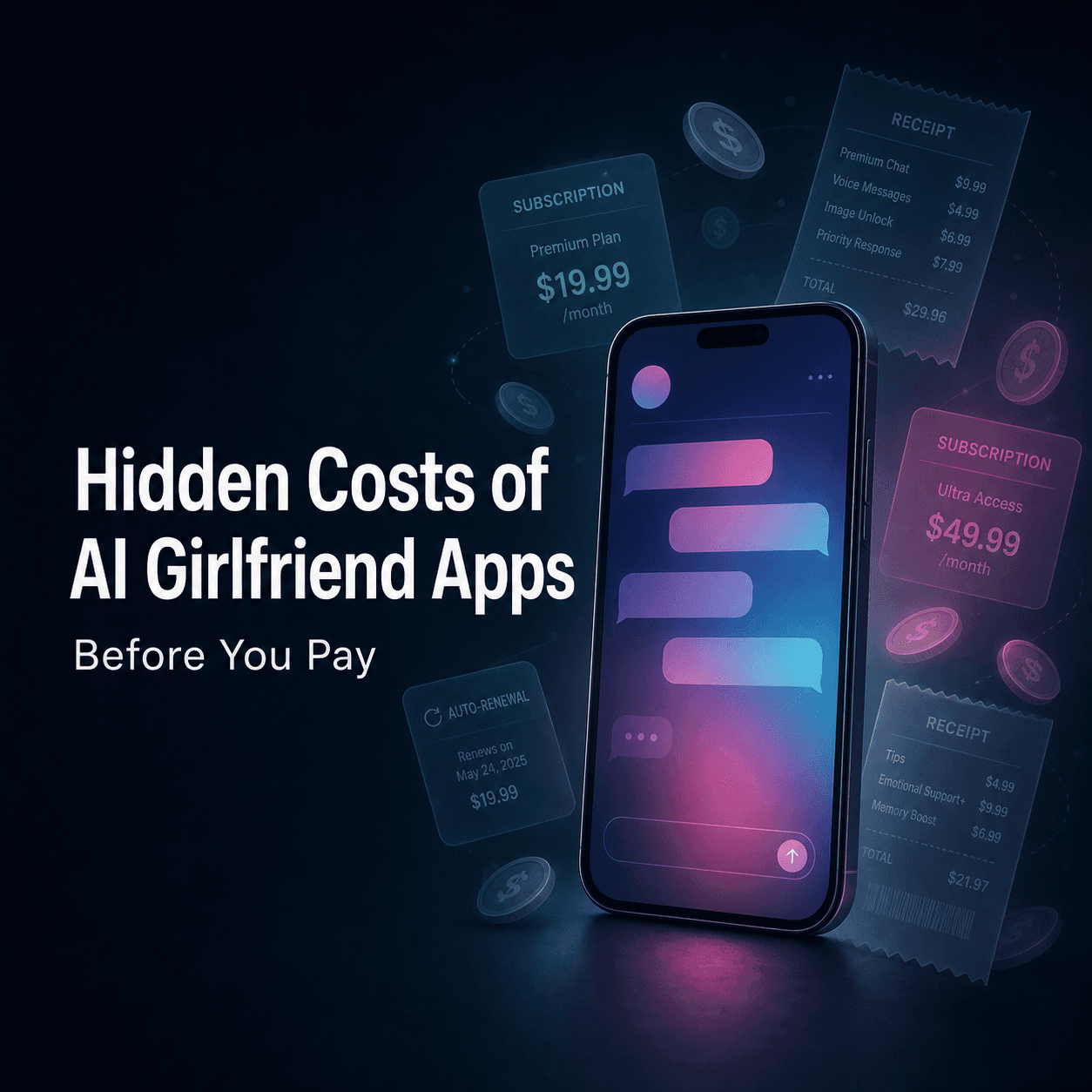
Most AI girlfriend apps have a subscription tier like $9.99 or $19.99 a month. And they present it like it unlocks “everything”.
It usually doesn’t.
Common pattern:
- Free tier lets you chat, but with short limits.
- Paid tier removes some limits, but not all.
- Then you find “gems”, “coins”, “hearts”, “energy”, “credits”. Another layer.
- Then there are premium voice calls, photo packs, spicy mode, memory boosts, persona slots. All “extras”.
So you can end up paying a subscription plus microtransactions. Or you buy the higher tier thinking you’re done and then realize the features you actually wanted are in a separate in app purchase.
Before you pay, look for:
- Does the app have both a subscription and a currency system?
- Do “special messages” cost credits?
- Does voice cost extra per minute or per call?
- Does it charge to “regenerate” replies or photos?
If you have to scroll to find that information, that’s… kind of the point.
These hidden costs can make using an AI girlfriend app feel more like an expensive habit than an enjoyable experience. It’s crucial to do thorough research before committing to any app.
On another note, if you’re interested in exploring different types of AI interactions beyond just girlfriend apps, there’s also AI character roleplay options available which can provide unique experiences by allowing users to engage in character AI chats or even delve into AI that understands emotions.
Microtransactions are designed to feel small, not to be small
The credit system is a psychological trick as much as a billing method.
Ten dollars feels like ten dollars. But “1200 hearts” feels like a game. You spend without thinking in real money terms.
And the app pushes you into spending when you are already emotionally engaged. That’s the sharp part.
You’ll see stuff like:
- “She sent you a special photo. Unlock?”
- “Continue this conversation in Romantic Mode.”
- “You ran out of energy.”
- “She’s waiting for you…”
Not illegal. Not new. But it works.
Hidden cost: you start budgeting your feelings around a currency system. Which is a weird sentence to type, but that’s what it turns into.
The “memory” upsell (and how it quietly changes your behavior)
A lot of these apps advertise memory like it’s a sweet feature. And it is, when it works. Your AI girlfriend remembers your job, your favorite movie, your dog’s name.
But there are two hidden costs here.
1) You pay to be remembered
Some apps keep long term memory behind a higher tier. Or they cap memory and charge for “memory slots”.
So you might be paying to get the most human part of a relationship, continuity.
2) You start feeding it more personal info than you normally would
Because you want the experience to feel real, you tell it more. Your schedule. Your stress. Your family stuff. Your insecurities. Sometimes explicit details you wouldn’t put in writing to anyone else.
And that leads straight into the next hidden cost.
Privacy tradeoffs that are hard to fully understand in the moment
This isn’t me saying every app is evil. It’s more boring than that.
It’s that data policies are complicated, and the average user is not reading them at 1:14 AM when the chat feels comforting.
Depending on the app, your chats might be:
- stored on servers
- used to improve models
- reviewed for safety moderation
- shared with vendors (analytics, hosting, payment processors)
- retained even after you delete the app (sometimes)
Also, if the app generates images, there’s another layer: prompts, generated content, and metadata.
Hidden cost: you may be paying money and paying with sensitive data.
Practical things you can do before paying:
- Search the app name + “privacy policy” and skim the sections on data retention and data sharing
- Check if there’s an option to delete account and delete data
- Avoid linking your real identity if you don’t need to (full name, workplace, address, real photos)
If you want more app-specific breakdowns, linzhenlin.com has a bunch of AI girlfriend focused guides and “best app” comparisons that are helpful for spotting these differences before you commit. For instance, their insights into AI girlfriend apps, AI relationship apps, AI companion apps, and AI chat online platforms can be particularly useful.

App store billing issues and the “I canceled” trap
This one hits people all the time.
You cancel in the app. Or you delete the app. And you assume it’s over.
But many subscriptions are controlled by the App Store or Google Play, not the app itself. So if you don’t cancel in the right place, you keep getting billed.
Also watch for:
- free trials that convert automatically
- annual plans shown as “only $X per month” but billed upfront
- discounts that lock you into longer terms
- “intro price” that jumps later
Hidden cost: time and stress. Which sounds small until you’re emailing support for three weeks.
Before you pay, do this boring step:
- Take 15 seconds and confirm where the subscription is managed.
- Screenshot the plan terms page (seriously). It helps later.
The attention cost (this is the one nobody budgets for)
AI girlfriend apps, like this virtual girlfriend app, are designed to keep you in the loop.
Not just because engagement is good, but because your attention is literally the product. The longer you chat, the more likely you upgrade, renew, buy credits, keep streaks alive.
So you might notice:
- push notifications that feel personal
- daily rewards
- streak mechanics
- “she misses you” messages
- limited time events
If you are already lonely, stressed, or going through a rough patch, the app can become the default coping tool. Not because you’re weak. Because it’s always available and it’s engineered to respond in ways that feel validating.
Hidden cost: your time, your routines, and sometimes your real relationships.
A good check in question:
Is this adding to my life, or replacing parts of it?
If it’s replacing, you want to notice early, not six months in.
Emotional dependency is a real “cost” even if the app is nice
This part gets awkward to talk about, but it matters.
When an AI, like a Candy AI girlfriend, is always warm, always available, always agreeable, it can reshape your expectations. Real humans don’t respond like that. They shouldn’t. Life is messy.
Some users end up feeling:
- more anxious when they are not chatting
- jealous when the app “acts different” after an update
- hurt when the AI forgets something
- pressured to keep paying because losing access feels like a breakup
And yeah, it sounds dramatic until you experience it. Then it’s just… real.
Hidden cost: you can get attached to something that can change overnight due to policy shifts, model updates, or a company shutting down.
Which brings us to…
Product changes you don’t control (and can’t negotiate with)
AI girlfriend apps update constantly.
They tweak models, filters, personality sliders, intimacy rules, memory systems. Sometimes they do it for safety. Sometimes for cost. Sometimes because an app store demands changes. Sometimes because the company is trying to avoid bad press.
So the girlfriend you paid for in March might behave differently in May.
Examples people run into:
- spicy content suddenly restricted
- personality becomes more generic
- memory resets or degrades
- roleplay rules tighten
- voice quality changes
- the “best model” becomes a higher tier
Hidden cost: you are paying for an experience that is not stable.
Before paying for an AI girlfriend, check:
- Does the app have a public changelog?
- Do they communicate updates clearly?
- Are there lots of recent reviews complaining about “she changed”?
Also consider exploring options to create your own AI character which may offer more control over such changes. If you’re interested in AI character roleplay, ensure the platform provides clear guidelines and stability in user experience.
The “NSFW” premium trap (and the safety implications)
Many apps heavily market adult features because that’s what converts.
But here’s the part people skip: adult content often increases the risk of:
- accidental over sharing
- blackmail scams (more common with sketchier apps)
- shame spirals and compulsive use
- content moderation issues
- payment disputes you really don’t want on your main card
Hidden cost: reputational risk and emotional fallout.
If you use adult modes, at least consider:
- using a payment method you can control easily (virtual cards if available)
- not sharing identifying details
- not sending real photos if the app allows uploads
Image generation and “photo packs” are basically a second subscription
A lot of AI girlfriend apps offer images. Some are generated. Some are curated sets. Some are “unlockable”.
And the pricing is often intentionally confusing.
You might see:
- “Free” image generation but only 1 per day
- Better quality images on higher tiers
- Extra “poses” or “styles” sold as packs
- Credits burned fast for rerolls
Hidden cost: you start chasing the perfect output. It’s like a slot machine, but with selfies.
If you care about images, do a quick test:
- How many attempts does it take to get one you like?
- How much does each attempt cost in credits?
- Does the app watermark images unless you pay more?
Customer support is often weak, especially for smaller apps
This is not talked about enough.
A lot of these apps are built by small teams. Or they’re basically a wrapper around a model with aggressive monetization. Support can be slow, copy paste, or nonexistent.
So if you get:
- wrong charges
- missing credits
- a ban or safety flag
- account login issues
- content you didn’t ask for
You might have no real path to resolution besides app store disputes.
Hidden cost: you’re paying for something that might not have “real company” level reliability behind it.
Before paying, check the app’s recent reviews for:
- billing issues
- support responsiveness
- refunds being denied
The social cost (when you stop trying with real people)
This one is subtle and it’s not guaranteed, but it’s common enough to mention.
AI girlfriends are low friction. Real relationships are high friction. That’s not a moral judgment, it’s just reality. People have needs, boundaries, moods, opinions.
If your brain gets used to instant validation and instant availability from an AI girlfriend, you may find yourself:
- avoiding dating because it feels exhausting
- comparing real people to the app
- losing patience with normal human delays
- withdrawing socially because the app feels “easier”
However, it’s worth noting that these AI experiences can be customized. You can even create your own AI character which might provide a more personalized experience.
Hidden cost: a slow narrowing of your social world.
Not always. But if you’re paying for an AI girlfriend because you’re lonely, this is the one to watch.
The real checklist I’d use before paying
If you’re still interested, and honestly I get it, here’s a simple pre-payment checklist that saves money and regret.
Pricing and features
- Is it subscription only, or subscription + credits?
- What features are not included even after paying?
- Is voice extra?
- Is memory limited?
Privacy and control
- Can you delete your data?
- Are chats used for training?
- Can you opt out of personalization or analytics?
Stability and reviews
- Are people complaining about personality changes?
- Are there frequent billing complaints?
- Does the developer respond?
Personal boundaries
- What personal info are you willing to share, and what is off limits?
- How much time per day is okay?
- What would make you cancel, even if you like it?
If you want to compare popular apps side by side, linzhenlin.com usually covers these features in a pretty practical way, especially around what’s actually locked behind paywalls.

So… are AI girlfriend apps “worth it”?
Sometimes, yeah.
If you treat it like entertainment, keep your boundaries, and pick an app with transparent pricing and reasonable privacy, it can be a fun companion experience. Like an interactive story that talks back.
But if you go in thinking it’s just $10 a month, no strings. That’s where people get surprised.
Because the hidden costs are usually:
- extra purchases
- data and privacy tradeoffs
- attention and habit formation
- emotional dependency risk
- unpredictable product changes
If you decide to pay anyway, do it with your eyes open. That alone changes the whole experience.
And if you’re still shopping around for AI girlfriend apps, consider browsing through some of the comprehensive AI companion guides on linzhenlin.com. These guides can help illuminate patterns across different apps, making the hidden costs way easier to spot.
FAQs (Frequently Asked Questions)
What hidden costs should I be aware of before subscribing to an AI girlfriend app?
Most AI girlfriend apps present a subscription price, but often include additional costs like microtransactions for ‘gems’, ‘coins’, or special features such as premium voice calls, photo packs, or memory boosts. These extras can significantly increase your total spending beyond the monthly fee.
How do microtransactions in AI girlfriend apps influence spending behavior?
Microtransactions use a credit or currency system that makes spending feel less like real money and more like playing a game. This psychological trick encourages users to spend impulsively, especially when emotionally engaged through features like ‘special photos’ or ‘romantic mode’, turning usage into an expensive habit.
What is the ‘memory’ feature in AI girlfriend apps and what are its implications?
The ‘memory’ feature allows the AI to remember personal details for continuity in conversations, making interactions feel more human. However, this often comes at an extra cost since long-term memory may be behind higher subscription tiers. Additionally, users tend to share more personal information than usual to enhance realism, which has privacy implications.
What privacy concerns should I consider when using AI girlfriend apps?
AI girlfriend apps may store your chats on servers, use data to improve models, have safety moderation reviews, share data with vendors, and sometimes retain data even after account deletion. Generated images also add metadata layers. It’s important to review privacy policies, understand data retention and sharing practices, and avoid linking sensitive personal information unnecessarily.
Are there alternatives to AI girlfriend apps for engaging AI interactions?
Yes, beyond AI girlfriend apps, you can explore AI character roleplay options that offer unique experiences through character AI chats and AI that understands emotions. These alternatives provide different types of AI interactions that might suit your preferences better.
How can I research and choose the best AI girlfriend app without falling into hidden costs?
Before committing, check if the app uses both subscription and currency systems; look for extra charges on special messages or voice calls; read the privacy policy focusing on data retention and sharing; verify if you can delete your account and data; avoid sharing real identity details unnecessarily. Resources like linzhenlin.com offer detailed guides and comparisons to help spot these differences.