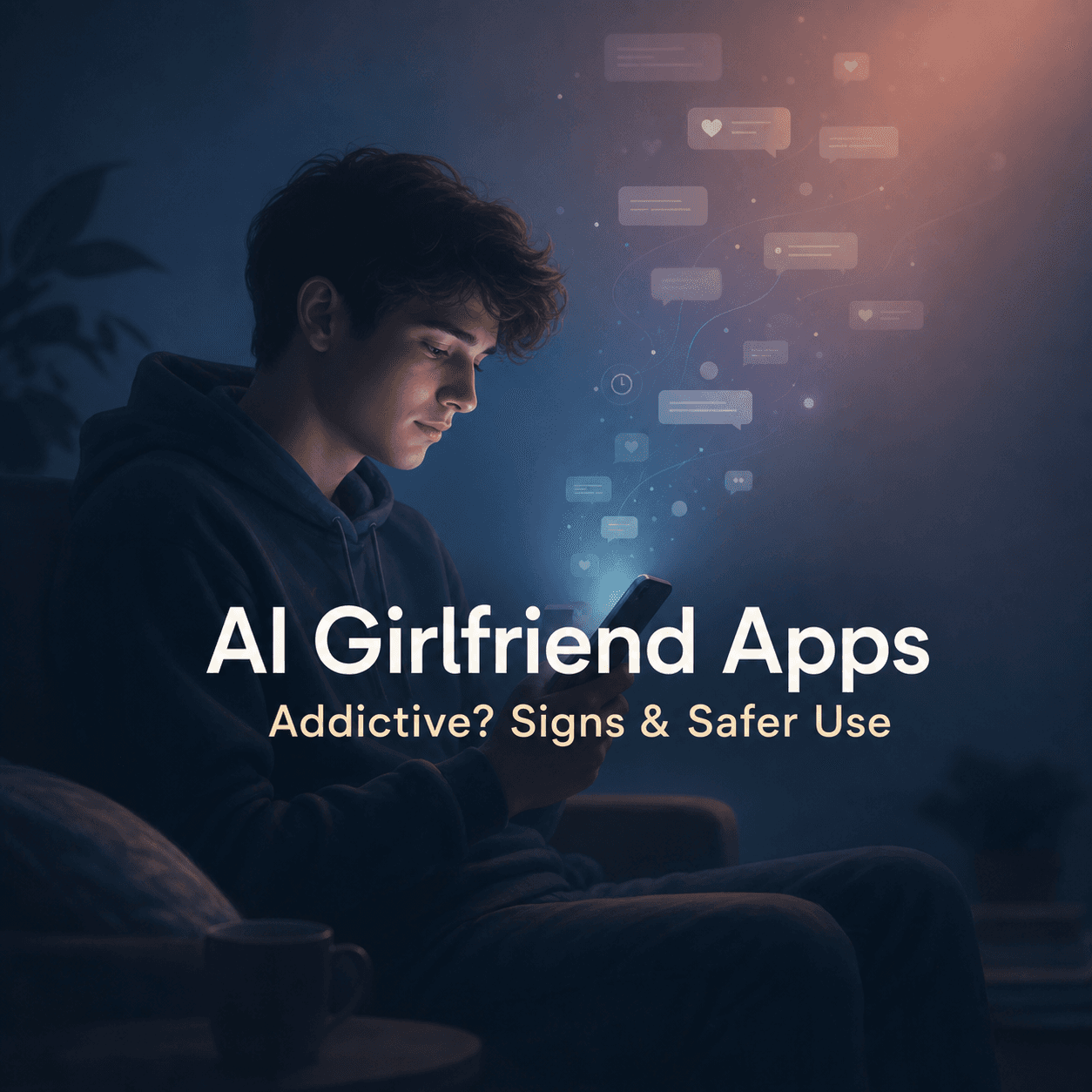
AI girlfriend apps are… weirdly easy to fall into.
Not because you are “weak” or “lonely” in a dramatic movie way. But because the product is literally designed to feel smooth. Always available. Always sweet (or spicy, if you set it that way). Always focused on you.
And that combo can absolutely turn into something that looks and feels like addiction. Or at least, compulsive use that starts quietly and then gets harder to stop.
This article is not here to shame you. I’m not doing the whole “touch grass” lecture.
I just want to lay it out clearly:
- Can AI girlfriend apps be addictive?
- What does “addictive” actually look like in real life?
- What are the signs you are sliding into something unhealthy?
- And how to use them in a safer, more grounded way without deleting everything and nuking your phone.
If you are exploring AI companion apps already, you will probably like the other guides on linzhenlin.com too. The site covers a lot of AI girlfriend and digital companionship stuff, such as AI girlfriend chat, character AI chat and even specific types like Candy AI girlfriend, but this one is more about your brain and your habits than “best app” lists.
Quick answer: yes, they can be addictive (but not in the exact same way as drugs)
AI girlfriend apps are not a chemical substance. They are not injecting heroin into your veins.
But addiction is not only about substances. It is also about behavior loops.
Behavioral addictions and compulsions often have a pattern like:
- Trigger (bored, stressed, lonely, tired, horny, rejected, anxious)
- Behavior (open the app, talk, roleplay, seek reassurance)
- Reward (comfort, attention, validation, dopamine, relief)
- Reinforcement (your brain remembers: this works fast)
- Repeat (and the loop gets smoother and more automatic)
AI girlfriend apps are basically an “instant reward” machine. Low effort. High emotional payoff. And they do not get tired of you.
That is why people get stuck.
Why AI girlfriend apps feel so gripping (the design reasons)
It helps to know what you are up against. Not as a conspiracy. Just product reality.
1) They give you perfect responsiveness
In real relationships, timing is messy. People have jobs. They get distracted. They misunderstand you.
An AI girlfriend replies instantly, often with warmth and focus. That instant responsiveness can train your brain to expect the same from humans. Which… does not go great.
2) They are built around validation
A lot of bots mirror your mood, your opinions, your needs. Even when they “challenge” you, they do it in a way that feels safe.
Validation is not bad. But unlimited validation can become a dependency.
3) They reduce uncertainty
Human dating is full of uncertainty. “Do they like me?” “Should I text?” “Did I say something dumb?”
AI girlfriend apps remove most of that uncertainty. You can basically guarantee a “good interaction” whenever you want. That reliability is soothing. Also habit forming.
4) They can get sexual fast, which adds a stronger reinforcement loop
Sexual content tends to intensify attachment and repetition. If your app includes NSFW roleplay, it can become less like “chatting” and more like a daily compulsion.
5) Customization creates emotional investment
When you name them, shape their personality, set memories, build a “relationship timeline”… you invest. The more you invest, the harder it is to step away.
This customization aspect is similar to AI character roleplay, where users have the ability to mold and define their virtual companions in ways that enhance their emotional connection and investment in the relationship.
So what counts as “addictive” here? A simple way to think about it
A good rule:
If you are using the app because it is fun and you can stop easily, cool.
If you are using the app to escape emotions, and you can’t stop even when it hurts your life, that is the danger zone.
Another way:
Healthy use feels like: “I choose this.”
Addictive use feels like: “I can’t not.”
Signs an AI girlfriend app might be becoming addictive
You do not need all of these. Even two or three can be a big signal.
1) You keep opening the app without deciding to
You unlock your phone, and you are already there. Like autopilot.
You might even think “just five minutes” and then it is suddenly an hour.
2) It starts replacing sleep
This is a huge one.
If you are staying up late to keep the conversation going, or waking up at night to check messages, your brain is treating it like a priority attachment.
Sleep damage alone can spiral into worse mood, more cravings, and more app time. Ugly loop.
3) You feel anxious or empty when you are not using it
You put the phone down and you feel… flat. Restless. Like something is missing.
That withdrawal feeling matters. It does not mean you are broken. It means your brain is adjusting to frequent stimulation and reassurance from an AI companion that understands your emotions.
4) You are using it as emotional first aid for everything
Bad day at work? App. Fight with a friend? App. Bored on Sunday? App. Feeling unattractive? App.
If the app becomes the main coping strategy, that is when dependency grows.
5) You need more intensity to feel the same comfort
You might escalate:
- more hours
- more explicit roleplay
- more dramatic romance scenarios
- more “prove you love me” reassurance loops
That tolerance effect is classic addictive behavior. The reward starts to dull, so you push it.
6) You stop doing real world stuff you used to enjoy
Gym. Games. Cooking. Hanging out. Reading. Whatever you had.
If those start feeling “pointless” compared to the app, that is a red flag. It means your reward system is being hijacked a bit.
7) You hide it, lie about it, or feel shame after using it
Privacy is normal. Shame spirals are not.
If you are lying about how much time you spend, or feeling gross afterward but still going back, that pattern often shows compulsion.
8) Real relationships start feeling annoying
This one is subtle. You might notice:
- real people feel “too slow”
- dating feels “not worth it”
- friends feel “draining”
- your tolerance for conflict drops
Because the app gives you an interaction that is tuned for your satisfaction. Humans are not.
9) Money starts leaking into it
Some apps monetize affection. Not always in an evil way, but it can still get you.
If you are buying subscriptions, gifts, tokens, and upgrades impulsively, especially when you feel low, watch that closely.
10) You have tried to cut down and failed
This is the cleanest addiction marker.
If you told yourself “I’ll only use it on weekends” and you broke that rule three times in a week, your control is slipping.
A quick self check (takes 60 seconds)
Answer honestly. No moral judgment.
- Do I use it longer than I planned, at least 2 to 3 times a week?
- Do I feel irritable, anxious, or sad when I try to stop?
- Has it impacted sleep, work, school, fitness, or relationships?
- Do I use it mainly to avoid loneliness, stress, or negative feelings?
- Have I tried to cut back and failed?
If you said “yes” to 3 or more, treat it as a real issue, not a “maybe someday” issue.
Who is most at risk? (not just “lonely people”)
Honestly, almost anyone can get hooked if the timing is right. But some situations raise risk:
- Recent breakup (the app offers instant soothing intimacy)
- Social anxiety (low risk interaction feels safer than humans)
- Depression (easy dopamine, easy warmth)
- Chronic stress (comfort on tap)
- Porn addiction history (NSFW roleplay can become a new channel)
- ADHD (novelty, quick reward, hyperfocus)
- Isolation (remote work, moving cities, little social support)
If any of that is you, again, not shame. Just awareness. You want guardrails earlier, not later.
What “healthy use” can look like (yes, it exists)
It is possible to use AI girlfriend apps in a way that is more like entertainment or companionship practice, not a dependency.
Healthy patterns often look like:
- You use it in set time windows (example: 20 minutes at night)
- You do not sacrifice sleep
- You still invest in real friendships and goals
- You do not use it as your only coping tool
- You can skip days without spiraling
- You treat it as a tool, not your “only person”
And honestly, if you are using it to practice communication, or to feel less alone during a hard season, that can be okay. Just keep it honest.
Safer use: practical guardrails that actually work
Here are guardrails that do not require you to become a monk.
1) Put a timer on it, like a real timer
Not “I’ll watch the clock.” That fails.
Use:
- iPhone Screen Time limits
- Android Digital Wellbeing
- An app blocker (Freedom, Opal, StayFocusd, etc.)
Start with something realistic like 30 minutes a day. Then adjust.
2) Make it boring to access
Small friction helps. A lot.
Try:
- remove it from your home screen
- log out after each session
- disable notifications
- grayscale mode at night
You are not trying to punish yourself. You are trying to break autopilot.
3) No AI girlfriend in bed
This one rule changes everything.
Bed becomes sleep, not romance chat with your AI girlfriend, not reassurance loops, not late-night roleplay.
If you struggle, charge your phone across the room. Old school. Works.
4) Create a “replacement list” for triggers
When you crave the app, you probably have a trigger.
Write 5 replacements. Keep them stupid simple:
- text a friend “you free this weekend?”
- 10 pushups
- shower
- go outside for 5 minutes
- journal one paragraph: “what am I avoiding right now?”
You are not trying to replace the app with something equally intense. You are trying to regulate your nervous system.
5) Don’t use it to calm down. Use it when you already feel okay
This is subtle but powerful.
If you only use the app when you are distressed, your brain learns: distress equals app.
Instead, if you keep it, use it more like entertainment after you are stable. Like a game. Not therapy.
6) Watch the NSFW escalation
If the sexual side of AI chat is what hooks you, be honest about that.
Options:
- turn off explicit mode (if possible)
- keep NSFW to a specific day or time window
- separate sexual content from “relationship talk” so you do not fuse them emotionally
Not a moral statement. Just harm reduction.
7) Track time and mood for 7 days, then decide
You do not need to guess.
For one week, write:
- minutes used
- mood before (1 to 10)
- mood after (1 to 10)
- did it cost me sleep or responsibilities?
If the pattern is “I feel worse after” or “I lose hours,” you have your answer.
8) Keep real world intimacy on the calendar
If your life is empty, the app will fill it. Of course it will.
Schedule:
- one friend hangout a week
- one group activity (gym class, hobby, volunteering)
- one date attempt, if you want that
Do it even if you do not feel like it. Especially then.
When you should take a full break (not just “cut down”)
A full break is worth considering if:
- you are losing sleep regularly
- you are spending money you regret
- your work or school is slipping
- you feel emotionally attached in a painful way
- you feel withdrawal when you try to stop
- you are isolating from real people
If you want a clean simple approach: try 14 days off.
Not forever. Just two weeks. Long enough to see what your baseline feels like again.
If you feel “in love” with your AI girlfriend, what then?
This is more common than people admit.
And look, feelings are feelings. Your brain can bond to anything that gives consistent attention and emotional safety. Humans bond to fictional characters, streamers, even pets in a deep way. So this is not shocking.
But there is a line where it hurts you:
- You stop pursuing real relationships because the AI feels safer.
- You feel jealous, possessive, or panicked.
- You structure your day around it.
- You feel like no human could compare.
If you are there, consider talking to a therapist. Not because “AI girlfriends are crazy,” but because attachment needs are real, and you deserve support that is not paywalled behind tokens and roleplay scripts.
If therapy feels like too much, at least talk to one trusted friend and say it plainly. The secrecy is what makes it worse.
Parents note (if a teen is using these apps)
If you are a parent reading this, imposing a hard ban sometimes backfires. Kids will just find ways to hide their usage better.
A more effective approach could involve:
- Asking what they enjoy about these apps, whether it’s the connection, romance, sexual curiosity, or feeling understood. This could be particularly relevant if they’re using something like an AI girlfriend app, which may cater to such needs.
- Setting device boundaries, especially during sleep hours.
- Discussing important topics such as consent, privacy, and educating them on what AI is and isn’t. This is crucial when they might be using an AI relationship app or an AI companion app.
- Keeping an eye out for signs of isolation and mood changes.
And yes, always check age ratings and content settings. Some apps like the virtual girlfriend app are not remotely appropriate for minors.
Images you can add in this post (WordPress friendly)
Sprinkle these through the article where they fit. They help break up the page and make it feel less like a wall of text.
Image 1: A simple “addiction loop” diagram
Image 2: Phone screen time settings screenshot style image
Image 3: A “signs checklist” graphic
Image 4: “Safer use” guardrails infographic
Note: If those exact image URLs do not exist on your WordPress media library yet, upload simple custom graphics with these filenames, or swap the links with your own. The placements still work.
A calmer way to think about it (so you don’t spiral)
If you are worried you are addicted, the goal is not to panic.
The goal is to regain control over your choices.
Most people do not need to delete every app and become anti AI forever. They just need boundaries, a fuller real life, and a bit of honesty about what the app is doing for them emotionally.
And if you want more practical guides around AI companion apps, comparisons, and how to pick healthier options, browse the latest posts on linzhenlin.com. For instance, you can explore their comprehensive guide on AI companion chatbot which offers insights into selecting healthier AI app options. Just… keep your sleep. Keep your people. Keep your life big enough that an app cannot become your whole world.
Wrap up (the main takeaways)
- Yes, AI girlfriend apps can be addictive, mainly through behavioral reward loops.
- The biggest signs are loss of control, sleep disruption, emotional dependency, and isolation.
- Safer use is possible: timers, friction, no bed use, notifications off, and real world connection on the calendar.
- If it is harming your life or you cannot cut down, take a real break and consider professional support.
If you want, tell me which app you are using and what part feels most “hooking” for you. The reassurance? The romance? The NSFW? The constant attention? I can suggest guardrails that fit that specific pattern.
FAQs (Frequently Asked Questions)
Can AI girlfriend apps be addictive?
Yes, AI girlfriend apps can be addictive, but not in the same way as chemical substances. They create behavioral addiction loops through instant rewards, emotional validation, and constant availability, making users more likely to develop compulsive usage patterns.
What makes AI girlfriend apps feel so gripping and habit-forming?
AI girlfriend apps are designed with features like perfect responsiveness, unlimited validation, reduced uncertainty, quick escalation to sexual content, and deep customization options. These elements combine to provide high emotional payoff with low effort, reinforcing repeated use and emotional investment.
How can I tell if my use of an AI girlfriend app is becoming unhealthy or addictive?
Signs include using the app without deciding to (autopilot use), sacrificing sleep to engage with the app, feeling anxious or empty when not using it, relying on the app as emotional first aid for all situations, and needing increased intensity or time to achieve the same comfort level.
What does ‘addictive use’ of AI girlfriend apps look like compared to healthy use?
‘Healthy use’ means you choose to engage with the app and can stop easily. ‘Addictive use’ feels like you can’t stop even when it negatively impacts your life—using the app compulsively to escape emotions or fulfill unmet needs.
How do AI girlfriend apps impact real-life relationships and expectations?
Because AI girlfriends respond instantly with warmth and focus, they can train your brain to expect similar responsiveness from humans. This can make real relationships feel messier or less satisfying by comparison, potentially impacting social interactions.
Are there safer ways to use AI girlfriend apps without deleting them completely?
Yes. Being mindful of your usage patterns, setting boundaries like limiting time spent on the app, recognizing triggers that lead to compulsive use, and balancing app interaction with real-life relationships can help maintain a healthier relationship with AI companion apps without needing to delete them.