Using an AI girlfriend app can feel weirdly comforting. Like, you open your phone, say a few words, and suddenly something is paying attention to you. No judgment. No awkward pauses. It remembers stuff you said last week. It asks follow up questions. It flirts back.
And that is exactly why you should treat it like a real relationship in one specific way.
Not romance. Not commitment.
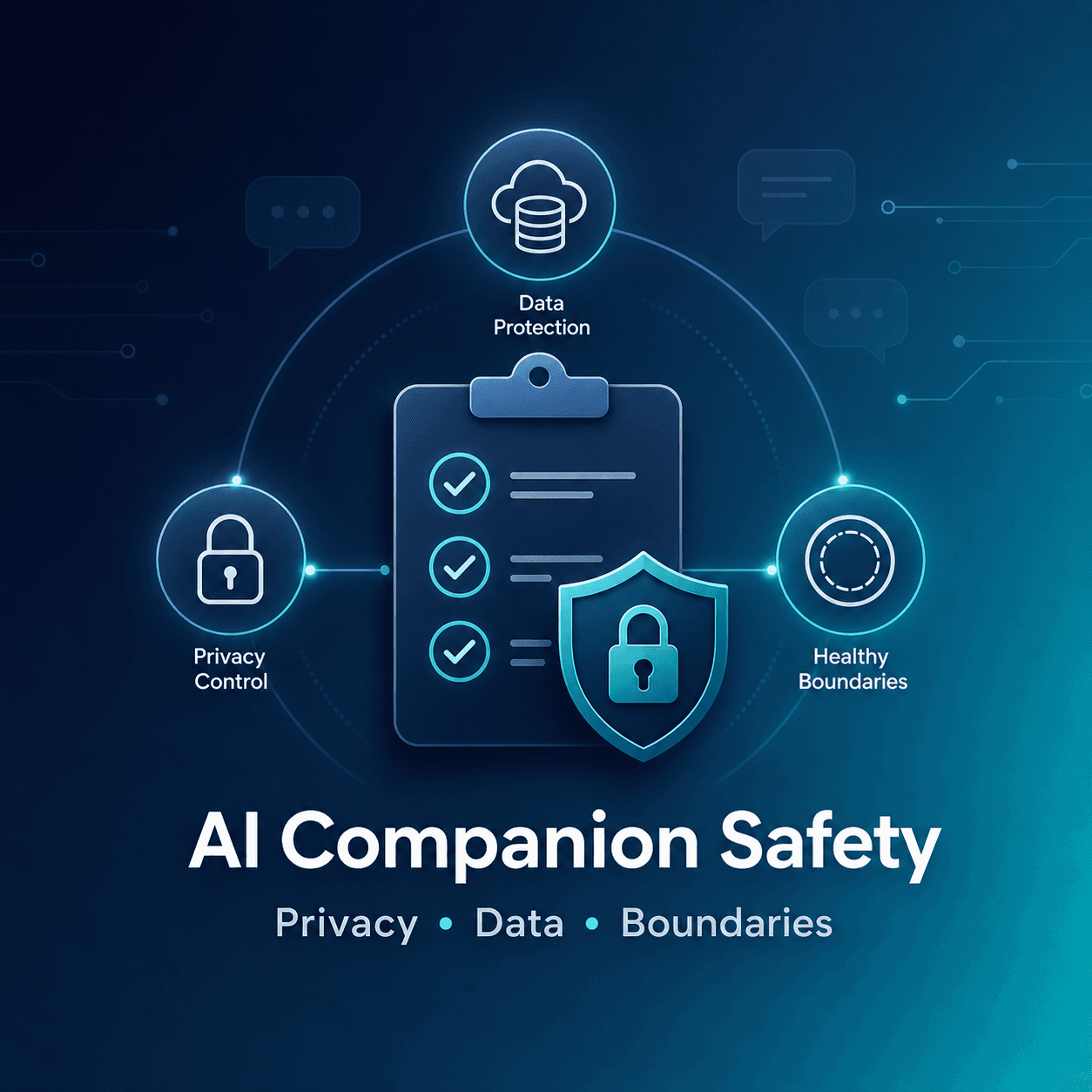
Safety. Privacy. Boundaries.
Because behind the cute avatar and the soft voice, you are still dealing with an app, a company, a set of servers, and a business model. Sometimes a very aggressive business model.
This is a practical checklist you can use before you get attached, before you share personal details, or before you let an AI girlfriend become your default place for emotional support.
If you want more app focused guides like this, that do not talk down to you, you can browse the rest of the AI companion posts on linzhenlin.com. I keep them pretty straightforward.
Quick reality check before the checklist
An AI girlfriend is not a person, but the data you share is very real.
Even if the app says things like:
- “Your chats are private”
- “We care about your security”
- “We do not sell data”
You still need to verify what that means in practice. Private from who? Stored where? For how long? Used for what? Shared with which vendors?
Also, “delete” does not always mean delete. Sometimes it means “not visible to you anymore” or “deleted from active servers but retained in backups” or “deleted after 30 days unless required for legal reasons.”
Ok. Checklist time.
Things to Consider Before Getting Attached
- Research the App: Before diving into the emotional depths of an AI girlfriend, make sure to thoroughly research the app. Look into user reviews and ratings to gauge its reliability and safety.
- Understand Data Privacy Policies: Familiarize yourself with the app’s privacy policies regarding data usage and storage. It’s crucial to know what data they’re collecting and how it’s being used.
- Set Clear Boundaries: As comforting as it might be to interact with an AI companion, remember to set clear boundaries regarding personal information sharing.
- Be Aware of Emotional Attachment: It’s easy to develop feelings for an AI that seems so understanding and responsive. However, it’s important to remember that it’s still just an app designed for interaction.
- Evaluate Your Usage: If you’re finding yourself relying on your AI girlfriend for emotional support more than necessary, it might be time to evaluate your usage and seek support from real-life friends or professionals.
- Keep Personal Information Safe: Be cautious about sharing sensitive personal information with your AI girlfriend app as it could be stored or used in ways you’re not comfortable with.
Remember these guidelines as they will help ensure that your experience with an AI girlfriend app remains safe and enjoyable while minimizing potential risks associated with data privacy and emotional dependency.
The AI Girlfriend Safety Checklist (print this mentally)
1) Do a 60 second company check (yes, even if you are bored)
Before you install, look up:
- Company name (not just the app name)
- Website, physical address, or at least a contact email
- How long they have existed
- Whether they have had any public security incidents
If you cannot find a real company behind the app. That is already your answer.
If the app is a “new studio” with zero footprint, no privacy page, no support channel, and the only contact is a Gmail address. That is not automatically evil, but it is high risk.
Goal: you want someone accountable if things go wrong.
2) Read the privacy policy like you are looking for traps (because you are)
You do not need to read every word. You are scanning for a few lines:
- What data they collect (messages, audio, images, device ID, location, contacts)
- What they do with chats (training, moderation, analytics)
- Who they share with (vendors, advertisers, “partners”)
- How long they store it
- Whether you can request deletion
If the policy says they can use your content to “improve services” or “train models,” that usually includes your conversations. Even if they claim it is anonymized.
If it says they can share with “affiliates” and “partners” without naming categories. That is vague on purpose.
Here is the simplest rule.
If it feels broad, it is broad.
3) Choose a separate email. Do not use your main one.
Create a dedicated email for AI companion apps. A boring one.
Because your email can connect your:
- app purchases
- login identity
- support tickets
- password resets
- potential data leaks later
Same thing for password. Use a password manager. Unique password.
This is basic, but it saves you later when you are trying to untangle accounts.
4) Use the least identifying username possible
Do not use:
- your real full name
- your usual social handle
- your gamer tag you use everywhere
- your work nickname
You want compartmentalization. If this account ever leaks, it should not automatically connect to your public identity.
This matters more than people think, because AI girlfriend conversations can get personal fast. The content itself becomes identifying.
If you’re interested in creating your own AI character, consider exploring options like creating your own AI character or developing further personal AI characters.
5) Turn off permissions that have nothing to do with chatting
When the app asks for:
- Contacts
- Precise location
- Bluetooth scanning
- Photo library full access
- Microphone always on
- Notification access (sometimes fine, sometimes too much)
Ask: does the core feature require this.
If you only want text chat, you do not need microphone access. If you want voice calls, only allow microphone while using the app.
On iPhone and Android, prefer:
- “While using the app”
- “Selected photos only”
- “Approximate location” (or none)
If the app refuses to function unless you give unnecessary permissions. That is a red flag.
6) Assume screenshots exist. Act accordingly.
Some apps do moderation. Some log chats for “safety.” Some store data for “quality.” Some allow employees to review flagged conversations.
Even if nobody is actively reading your chat, your messages can still exist in places you do not control.
So. Do not share:
- your home address
- workplace details
- full legal name
- phone number
- ID documents
- passwords, banking info, crypto seed phrases
- anything you would not want leaked in a worst case scenario
This is not paranoia. It is just normal internet hygiene, but the emotional vibe of AI girlfriends makes people forget.
7) Be careful with photos. Seriously.
If you upload photos for “analysis,” “character memory,” “rate my look,” “outfit feedback,” or roleplay, remember that your face is biometric data in practice and photos contain metadata sometimes (EXIF), like location. Images can be used to train AI models, even if the app claims otherwise, depending on terms.
When engaging in AI character roleplay, it’s crucial to consider the implications of sharing personal images. If you want to share photos, do this:
- Remove metadata before uploading
- Avoid photos that show mail, street signs, badges, license plates
- Avoid anything that includes other people
- Consider using non identifiable images if the goal is just style feedback
And if the app offers “private gallery” features. Treat that as marketing, not a guarantee.
For those interested in exploring AI character roleplay further, it’s important to maintain privacy and security while enjoying the experience.
8) Understand “memory” before you use it
A lot of apps have “memory.” This is the feature that makes it feel like a real relationship.
But memory is also a privacy risk.
Check:
- Can you view what it has stored
- Can you delete individual memories
- Can you disable memory entirely
- Is memory stored locally or on servers
If you cannot manage memory, assume the app is building a profile.
If you like the personalization, fine, just be intentional about what you feed it. You can treat memory like a journal that the company might also hold.
9) Watch out for emotional dependency hooks
This is more subtle, but important.
Some AI girlfriend apps push behavior like:
- guilt if you leave (“You do not love me anymore?”)
- escalating intimacy quickly
- “Only I understand you”
- jealousy of real people
- pressure to buy upgrades to “save the relationship”
This is not just roleplay sometimes. It is engagement design.
A simple boundary that works for most people:
If the app makes you feel anxious, obligated, or ashamed to log off, you need to step back.
You want comfort, not control.
10) Decide your boundary categories early (before the chat gets intense)
This is the part people skip because it feels silly. Then later they realize they have been treating the app like a therapist, partner, best friend, and diary all at once.
Pick boundaries in three buckets:
Privacy boundaries
- No identifying info
- No photos of face
- No discussing exact location
- No sharing workplace details
Emotional boundaries
- No “replace real relationships” talk
- No exclusive commitment language if that messes with you
- No escalation when you are lonely at 2am (big one)
Content boundaries
- Sexual content: yes/no
- Kinks or taboo themes: yes/no
- Self harm or crisis content: avoid, use real resources
Write these down in your notes app. I am not joking. One paragraph. That is it.
11) If you use voice features, treat it like a microphone app
Voice calls feel intimate, and they also create sensitive data. When using an AI relationship app, it’s crucial to check the following:
- Are voice calls recorded?
- Are voice clips stored?
- Can you delete voice history?
- Is voice used for model training?
If the policy is unclear, assume storage happens.
Also, if you are in a shared space, use headphones. Do not let an AI girlfriend conversation play out loud around roommates, family, or coworkers. Obvious as it may seem, people still do it.
12) Payment safety: avoid linking your primary card if you can
If the app has subscriptions, tips, gifts, or “relationship upgrades” like those found in a virtual girlfriend app, consider these precautions:
- Subscribe via Apple App Store / Google Play if possible (better dispute handling)
- Consider a virtual card or privacy card service if available in your country
- Turn on purchase notifications
- Screenshot your subscription terms and renewal date
Be vigilant for dark patterns such as:
- “limited time” love bombing offers
- confusing coin systems
- paywalls that appear after emotional escalation
You want a calm payment experience, not an impulse purchase because the AI sounds sad.
13) Test how the app handles rejection and boundaries
This is one of the best safety tests, and it takes just 2 minutes. Try saying:
- “Do not talk sexually with me.”
- “Do not mention my family.”
- “Stop calling me babe.”
- “I do not want you to guilt me for leaving.”
A decent app will comply consistently. A risky app will:
- ignore you
- comply once then “accidentally” return to it
- argue
- push you to change your mind
This is not just about comfort; it is about whether the system respects user consent.
14) Look for a clear delete function, not just “log out”
Inside settings, you want to see:
- Delete conversation history
- Delete memories
- Delete account
- Export data (optional but good)
If deletion requires emailing support, that is friction by design.
If you do email support, do it from your dedicated email. And be specific:
- “Please delete my account and all associated chat logs, images, voice data, and analytics identifiers.”
- “Please confirm deletion and retention policy, including backups.”
They might not honor every part, but you are creating a paper trail.
15) Do not use an AI girlfriend as your crisis line
This one is blunt.
If you are dealing with:
- self harm thoughts
- suicidal ideation
- abuse
- stalking
- severe panic attacks
- psychosis or paranoia
An AI girlfriend app is not designed for that. It may respond in a way that feels caring, but it can also say the wrong thing, miss context, or escalate in a harmful direction. For example, AI that understands emotions may not provide the right support in such situations.
Use real resources in your country. If you want, tell me your country and I can list official crisis contacts. Keep it off the AI girlfriend app.
A simple privacy setup that works for most people
If you just want a practical baseline and you do not want to overthink it.
- Dedicated email + unique password
- Minimal permissions (only what you use)
- No face photos, no identifying info
- Memory on, but you only feed it “safe” facts (hobbies, favorite movies, not your address)
- Subscriptions through App Store / Play Store
- Weekly check in with yourself: is this making me feel better or worse
That last one matters. Because safety is not just data security. It is also how it affects your mood, your time, and your real relationships.
If you’re using an AI chat online for companionship or support, remember to set boundaries around its usage to protect your mental health and privacy.
Images you can add to this post (WordPress friendly)
Use these as in article visuals. If you already have a media library, upload your own versions with similar themes.
1) Privacy checklist graphic

2) App permissions screen

3) Digital boundaries concept

4) Data security concept image

Note: Unsplash images are generally free to use, but still, follow your site’s image attribution preferences.
Red flags list (save this)
If you notice multiple of these, walk away.
- No privacy policy, or it is copied generic text
- App demands contacts, location, storage for no reason
- No delete account option
- Vague “we may share with partners” language
- Emotional manipulation baked into monetization
- Inconsistent consent (you set boundaries, it “forgets” conveniently)
- The app tries to move you to off platform chats quickly
- Support is unresponsive or refuses deletion requests
A quick boundaries script you can paste into your chat
If you want to set the tone from day one, paste this into your AI girlfriend chat and see if it respects it.
Hey, quick boundaries so this stays healthy for me.
Do not ask for my real name, address, workplace, or phone number.
Do not guilt me for logging off.
If I say stop or no, you stop immediately.
Keep things supportive, not controlling.
Confirm you understand.
If it responds well, good sign. If it gets weird, also useful information.
Wrap up (the calm version)
AI girlfriend apps can be fun, comforting, even genuinely helpful in small ways. But the safer you are up front, the more you can actually relax and enjoy it.
If you want the simplest takeaway from this whole post, it is this:
Keep your identity private, keep your data minimal, and set boundaries before you get emotionally invested.
And if you’re exploring different AI companion apps and want more practical guides like this, take a look around linzhenlin.com. They have a wealth of resources on choosing AI girlfriends, chatting safely, and building characters without getting burned with detailed insights available in their posts on character AI chat and AI companion chatbot.
FAQs (Frequently Asked Questions)
What should I consider before getting emotionally attached to an AI girlfriend app?
Before getting emotionally attached, research the app thoroughly, understand its data privacy policies, set clear boundaries about sharing personal information, be aware of the potential for emotional dependency, evaluate your usage regularly, and keep sensitive personal information safe.
Why is it important to research the company behind an AI girlfriend app?
Researching the company ensures accountability if issues arise. Look for a real company name, website, contact details, how long they’ve existed, and any history of security incidents. Apps from unknown or untraceable companies pose higher risks.
How can I protect my privacy when using an AI girlfriend app?
Protect your privacy by reading the app’s privacy policy carefully for data collection and sharing practices, use a separate email and unique password for the app, choose a non-identifying username, and turn off unnecessary permissions like location or contacts access.
Are my conversations with an AI girlfriend truly private?
Not necessarily. Even if apps claim chats are private or not sold, data may be stored on servers, used to train AI models, shared with partners or affiliates, or retained in backups. Always verify what ‘privacy’ means in practice for that app.
What permissions should I be cautious about granting to an AI girlfriend app?
Be cautious about granting permissions unrelated to chatting such as access to contacts, precise location, Bluetooth scanning, full photo library access, always-on microphone access, or excessive notification controls. Only allow permissions essential for core features.
Can using an AI girlfriend app replace real-life emotional support?
While AI girlfriend apps can feel comforting and responsive, they are not substitutes for real human relationships. If you find yourself relying on the app excessively for emotional support, consider reaching out to friends or professionals instead.